.png)
Introduction
Around the world, countries and cities are accelerating the transition toward carbon neutrality and greener transportation. China, the United States, and the European Union have all announced long-term carbon reduction goals, while many developing regions in Southeast Asia, the Middle East, and Latin America are also promoting the shift from gasoline-powered motorcycles to electric mobility solutions.
At the same time, rising global fuel prices are making electric transportation not only an environmental choice, but also a more economical long-term solution for both users and operators.
Against this background, shared e-bike systems are becoming increasingly popular in urban transportation scenarios. Compared with traditional public transportation, shared e-bikes provide a more flexible and efficient solution for short-distance travel.
Today, shared e-bikes are widely used in:
Users can quickly unlock a nearby e-bike through a mobile app and travel conveniently between offices, subway stations, classrooms, shopping areas, and scenic spots while avoiding traffic congestion and parking difficulties.
As cities continue to pursue smarter and greener transportation systems, shared e-bike platforms are becoming an important part of modern urban mobility infrastructure.
What Is a Shared E-bike System?
A shared e-bike system is a smart mobility solution that allows users to rent electric bicycles or electric scooters for short-distance transportation through a mobile application.
Unlike traditional bicycle rental services, modern shared e-bike systems are built on IoT (Internet of Things) technology, cloud management platforms, GPS positioning, mobile payment systems, and intelligent operation management tools.
A complete shared e-bike system usually includes:
- Smart electric bikes or scooters
- IoT smart control devices
- User mobile applications
- Operation and maintenance platforms
- GPS positioning systems
- Smart parking technologies
- Fleet management systems
- Data analysis platforms
The entire system works together to help operators manage thousands or even tens of thousands of vehicles efficiently across cities, campuses, scenic areas, or commercial districts.
Find a vehicle, scan the QR code, ride to the destination, and return the vehicle in a designated parking area.
Running a shared e-bike business requires a complex combination of intelligent hardware, software systems, data management, and operational strategies.
How Does a Shared E-bike System Work?
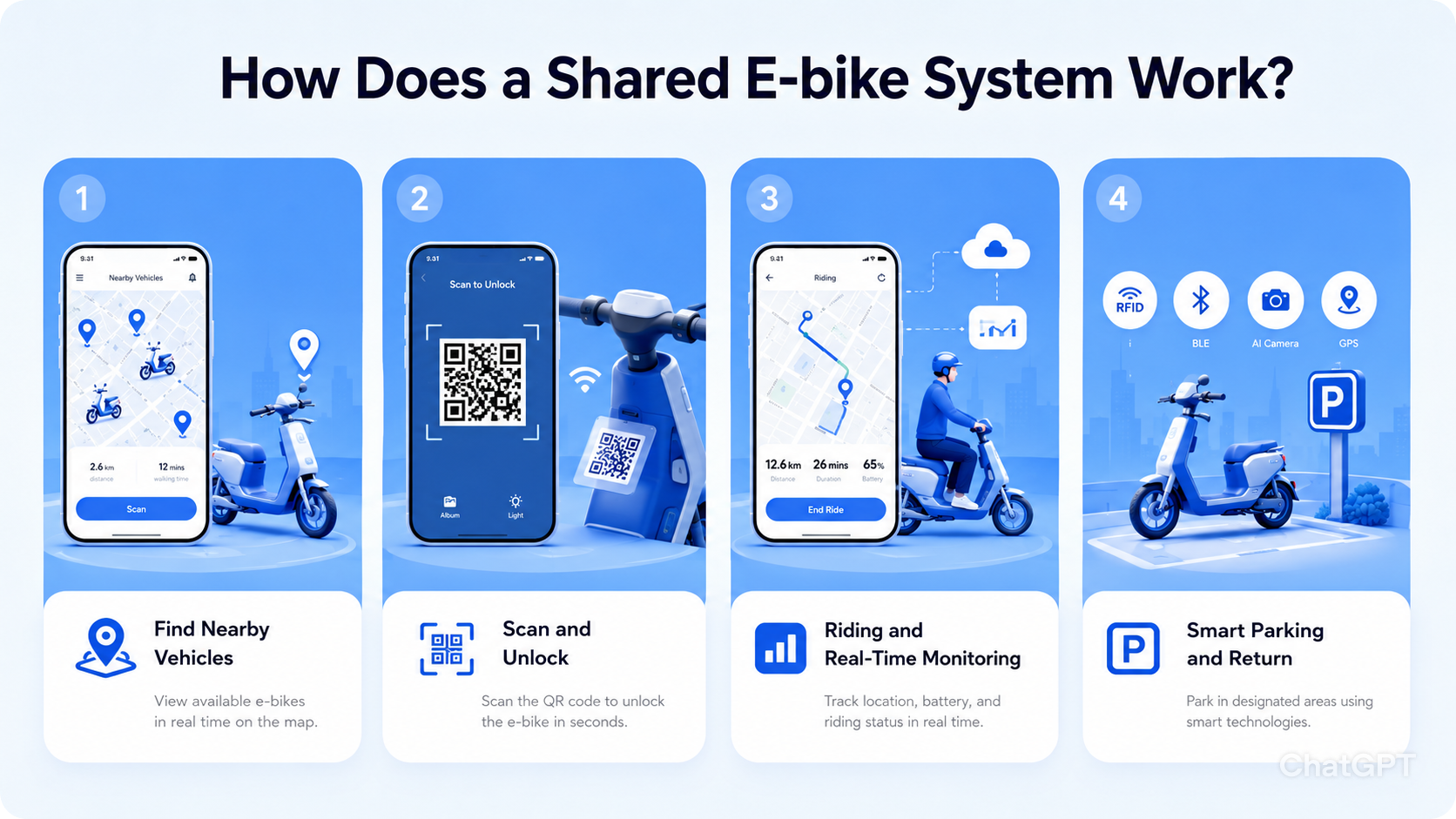
Although the user experience appears simple, a shared e-bike platform relies on multiple technologies working together in real time.
Users open the mobile app to view nearby available e-bikes on the map. The platform uses GPS and IoT connectivity to display real-time vehicle locations, battery levels, and parking status.
Users scan the QR code on the vehicle using the mobile app. The IoT device communicates with the cloud platform through a 4G network and automatically unlocks the vehicle in only a few seconds.
During the ride, the IoT system continuously uploads:
- Vehicle location
- Riding status
- Battery information
- Abnormal movement alerts
- Speed and operational data
Users return the e-bike per platform parking rules. Operators use smart technologies to ensure proper parking:
- RFID parking
- BLE spike parking
- AI camera recognition
- High-precision positioning
- Vertical parking technology
Key Components of a Shared E-bike System
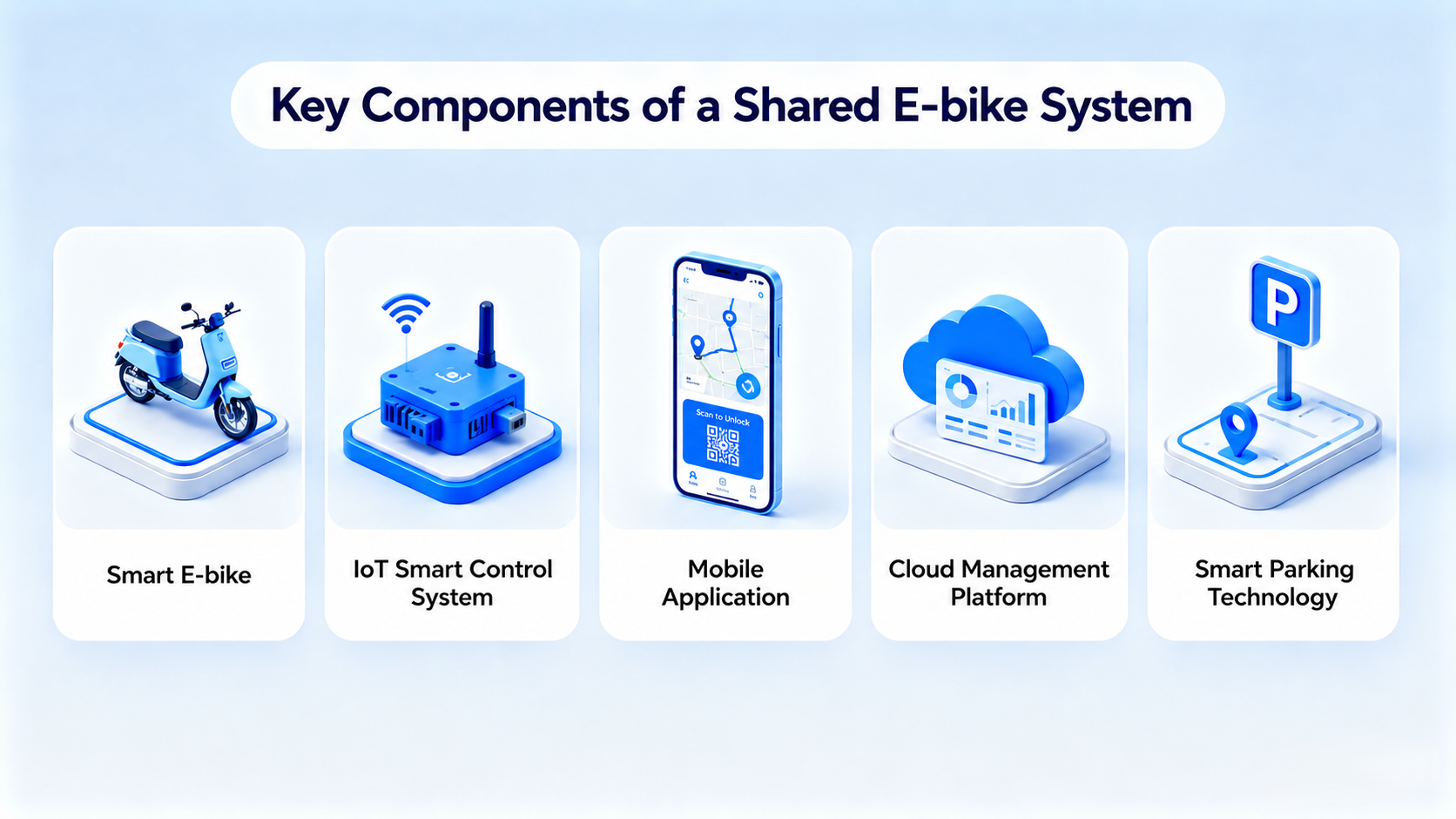
Smart E-bike
The vehicle itself is the foundation of the system. Most shared e-bikes are designed specifically for commercial operation and usually include:
- Durable frame structures
- Long-life batteries
- Integrated smart locks
- Waterproof electronic systems
- Anti-theft protection
Commercial shared e-bikes also need to support high-frequency daily usage and long-term outdoor operation.
IoT Smart Control System
The IoT device is the “brain” of the shared e-bike. It enables functions such as:
Modern IoT systems also support:
These technologies allow operators to manage vehicles remotely and improve operational efficiency.
Mobile Application
The user app is the main interface between the platform and riders. Typical app functions include:
- Vehicle search
- QR code scanning
- Payment
- Temporary parking
- Ride history
- Navigation
- Customer support
A good user experience is critical for improving user retention and ride frequency.
Cloud Management Platform
Behind every shared e-bike platform is a powerful cloud management system. Operators use the platform to:
- Monitor vehicle status
- Analyze ride data
- Manage battery operations
- Configure service areas
- Dispatch maintenance teams
- View heat maps and usage trends
- Manage pricing and marketing activities
For large-scale projects, intelligent operation platforms are essential for reducing operating costs and improving fleet efficiency.
Smart Parking Technology
Parking management is one of the biggest challenges in the shared mobility industry. Without effective parking management, cities can quickly face issues such as:
To solve these problems, operators are increasingly adopting intelligent parking technologies such as:
- RFID fixed parking
- BLE spike parking
- AI camera recognition
- High-precision RTK positioning
- Vertical parking detection
Smart parking systems not only improve urban management but also enhance the user riding experience.
Benefits of Shared E-bike Systems
Shared e-bikes help reduce carbon emissions and decrease dependence on fuel-powered transportation, becoming an important part of sustainable urban transportation strategies worldwide.
For short-distance trips, shared e-bikes can significantly improve travel efficiency and reduce traffic pressure in crowded city areas.
Compared with cars or motorcycles, shared e-bikes provide a more affordable transportation option for daily users.
Shared e-bike systems can be deployed in many scenarios, including:
- Cities
- Universities
- Industrial Parks
- Tourist Attractions
- Residential Communities
Challenges in Shared E-bike Operations
Although the market is growing rapidly, shared e-bike operations still face several major challenges.
Random parking remains one of the biggest problems for operators and city managers.
High-value outdoor assets require intelligent anti-theft systems and real-time monitoring capabilities.
Efficient charging and battery replacement operations are critical for maintaining fleet availability.
Operators need to balance vehicle distribution across different areas based on real-time demand.
Issues such as multiple riders, riding without helmets, and traffic violations are becoming increasingly important in urban shared mobility management.
The Future of Shared E-bike Systems
As IoT, AI, and smart city technologies continue to develop, shared e-bike systems are becoming more intelligent and more connected.
Future trends may include:
In many cities, shared e-bikes are no longer viewed simply as rental vehicles, but as part of the urban transportation infrastructure.
Conclusion
Shared e-bike systems are transforming the way people travel in cities around the world.
Driven by environmental goals, rising fuel costs, and the growing demand for convenient short-distance transportation, shared mobility is becoming an important part of modern urban life.
Behind every successful shared e-bike project is a combination of intelligent vehicles, IoT technology, smart parking systems, and powerful operation platforms.
As the industry continues to evolve, operators that combine smart technology with efficient operational management will play an increasingly important role in the future of urban mobility.
Post time: May-18-2026


