.png)
Introduction
As cities around the world continue to promote green transportation and smart urban infrastructure, shared e-bike services are becoming an important part of modern mobility ecosystems. From Southeast Asia and the Middle East to Europe and Latin America, more operators are deploying shared e-bike fleets to solve last-mile transportation challenges and reduce carbon emissions.
However, operating a large-scale shared e-bike fleet is no longer just about putting vehicles on the street. Operators today face increasing challenges related to parking management, vehicle security, rider behavior, dispatch efficiency, and urban compliance.
To solve these issues, smart IoT technologies are becoming the core foundation of modern shared mobility systems.
Smart IoT for shared e-bike fleets combines intelligent hardware, cloud platforms, mobile applications, AI analytics, and high-precision positioning technologies to help operators manage vehicles more efficiently, reduce operating costs, and improve user experience.
The Main Challenges of Shared E-bike Fleet Operations
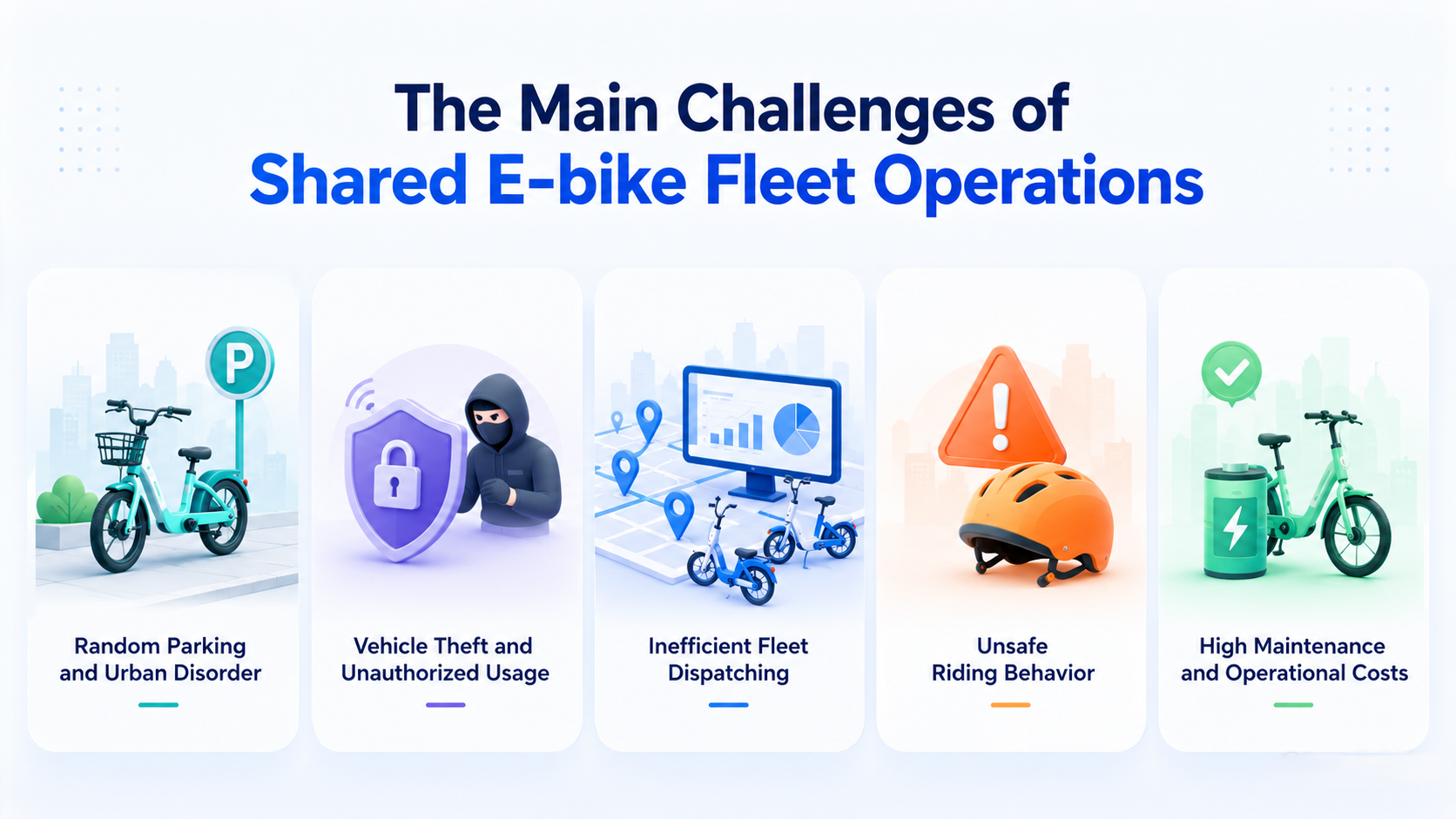
Managing hundreds or even thousands of shared e-bikes across a city can quickly become complex without intelligent systems. The following are some of the most common operational challenges faced by shared mobility operators.

1 Random Parking and Urban Disorder
Improper parking is one of the biggest problems in the shared mobility industry. Randomly parked e-bikes can block sidewalks, create traffic issues, and negatively impact the urban environment.
Many cities are now introducing stricter parking regulations for shared mobility operators. Without effective parking management technologies, operators may face penalties, operational restrictions, or user complaints.
Smart IoT systems can solve this problem through technologies such as:
- High-precision positioning
- RFID fixed parking
- BLE road spike parking
- AI camera recognition
- Vertical parking detection
These technologies help ensure that users return vehicles correctly within designated parking zones.
2 Vehicle Theft and Unauthorized Usage
Shared e-bikes are valuable assets that operate in open public environments, making them vulnerable to theft and misuse.
Traditional GPS tracking alone is often not enough for large-scale fleet protection. Modern IoT systems now integrate:
- Real-time GPS tracking
- Geo-fence management
- Vibration detection
- Wheel movement detection
- Remote vehicle locking
- Intelligent alarm systems
These features significantly improve vehicle security while helping operators monitor abnormal vehicle behavior in real time.
3 Inefficient Fleet Dispatching
Fleet balancing and vehicle dispatching are critical for maintaining operational efficiency. Without accurate operational data, some areas may suffer from vehicle shortages while others experience oversupply.
Smart IoT platforms help operators optimize fleet management through:
- Real-time vehicle monitoring
- Heat map analytics
- Demand forecasting
- Smart dispatch recommendations
- Battery management systems
- Operation dashboards
By analyzing riding patterns and regional demand, operators can improve vehicle utilization and reduce labor costs.
4 Unsafe Riding Behavior
As shared e-bike usage grows, rider safety is becoming increasingly important for both operators and city governments.
Some common safety concerns include:
- Riding without helmets
- Multiple riders on one vehicle
- Wrong-way riding
- Running red lights
- Dangerous riding behavior
AI-powered IoT systems can assist operators and cities by identifying unsafe riding activities and improving urban traffic management.
What Is Smart IoT for Shared E-bike Fleets?
Smart IoT for shared e-bike fleets is a complete intelligent mobility management system that connects vehicles, users, operators, and cloud platforms in real time.
It typically includes:
Unlike traditional vehicle tracking systems, modern smart IoT platforms provide full operational visibility and intelligent automation for shared mobility businesses.
Key Technologies Behind Smart Shared E-bike Systems
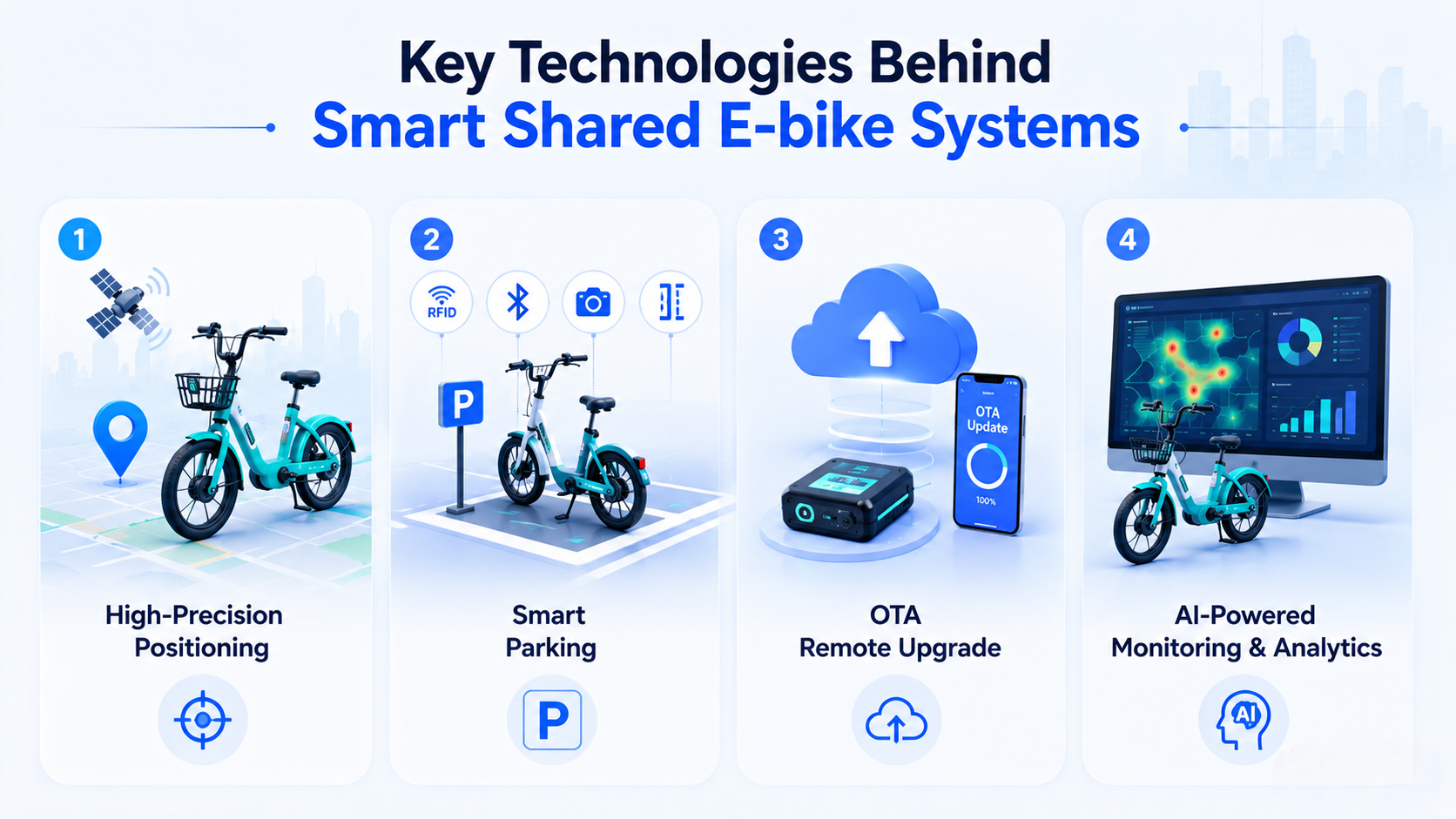
Real-Time GPS and High-Precision Positioning
Accurate positioning is one of the most important technologies in shared e-bike operations.
Modern IoT devices now support:
- 4G LTE communication
- Dual-frequency GPS
- RTK positioning
- Sub-meter positioning accuracy
- Real-time location tracking
High-precision positioning improves parking accuracy, fleet visibility, and operational efficiency.
Some advanced IoT devices can achieve positioning accuracy within one meter in open environments, helping operators create more reliable parking and geo-fence systems.
Smart Parking Technologies
Parking compliance is now a key requirement in many cities. Different smart parking technologies are being widely adopted across the industry.
RFID Fixed Parking
RFID tags installed at parking stations allow the system to identify whether vehicles are returned within approved areas. This solution is cost-effective and suitable for large-scale deployments.
BLE Road Spike Parking
BLE road spike technology uses Bluetooth signals to achieve highly accurate parking verification with an error margin of less than two meters. This technology is increasingly used in dense urban environments.
AI Camera Recognition
AI cameras can automatically detect vehicle posture, illegal parking behavior, and parking compliance. Combined with intelligent voice prompts, operators can improve user parking behavior without manual intervention.
Vertical Parking Detection
Vertical parking technology monitors vehicle parking angles through IoT sensors and geomagnetic data analysis. If the vehicle is parked incorrectly, users may be unable to complete the ride until proper parking adjustments are made. This significantly improves parking order and urban management efficiency.
OTA Remote Upgrade Capabilities
Modern shared e-bike fleets may include thousands of connected vehicles operating across multiple cities.
Remote OTA (Over-The-Air) upgrade technology allows operators to update:
- IoT firmware
- Vehicle controllers
- BMS systems
- Functional configurations
without recalling vehicles from the field.
OTA capability greatly reduces maintenance costs and improves long-term fleet scalability.
AI-Powered Fleet Monitoring and Analytics
Artificial intelligence is becoming increasingly important in shared mobility operations.
AI-powered platforms can help operators:
- Analyze rider behavior
- Predict fleet demand
- Identify high-traffic areas
- Optimize dispatching
- Detect traffic violations
- Improve operational efficiency
Through real-time analytics and visualization dashboards, operators can make faster and more accurate business decisions.
Benefits of Smart IoT for Shared E-bike Operators
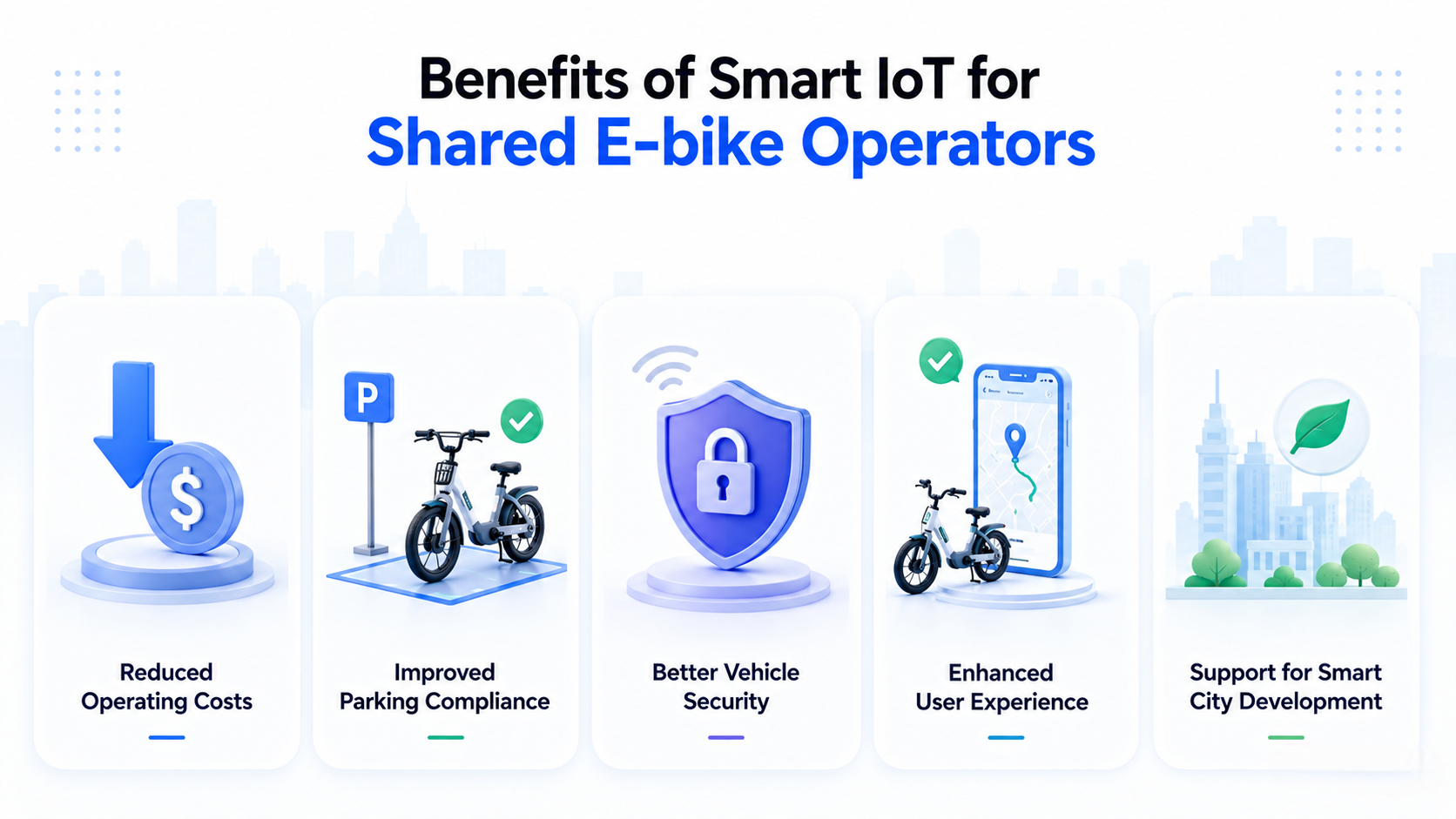
Reduced Operating Costs
Smart dispatching, remote diagnostics, and intelligent maintenance systems help reduce operational and labor expenses.
Improved Parking Compliance
Advanced parking technologies reduce random parking issues and help operators meet local government regulations.
Better Vehicle Security
Real-time monitoring and intelligent anti-theft systems improve asset protection and reduce vehicle loss.
Enhanced User Experience
- Faster vehicle locating
- Convenient unlocking
- Accurate parking guidance
- Safer riding environments
- More reliable vehicle availability
Support for Smart City Development
Shared e-bike IoT systems also contribute to broader smart city initiatives by improving urban transportation efficiency and reducing traffic congestion.
Real-World Applications of Smart Shared Mobility
Smart IoT technologies are already being widely used in international shared mobility projects.
Korea: Shared mobility platforms such as Kakao Mobility have introduced shared e-bike services for short-distance transportation in urban areas.
Türkiye: Marti operates large fleets of e-mopeds, e-bikes, and e-scooters supported by proprietary IoT infrastructure and intelligent fleet management systems.
Southeast Asia and China: Operators are deploying large-scale RFID parking systems, BLE parking solutions, and high-precision positioning technologies to improve urban mobility management.
These real-world deployments demonstrate how smart IoT is becoming a critical component of modern shared transportation ecosystems.
The Future of Smart Shared E-bike Fleets
The shared mobility industry is continuing to evolve rapidly.
Future trends may include:
- AI-driven fleet scheduling
- Autonomous maintenance prediction
- Battery swapping integration
- Vehicle-to-infrastructure communication
- More advanced rider safety systems
- Deeper integration with smart city infrastructure
As cities continue to modernize transportation systems, intelligent IoT platforms will play an increasingly important role in enabling scalable, compliant, and sustainable shared mobility operations.
Conclusion
Shared e-bike fleets are becoming an essential part of modern urban transportation. However, large-scale fleet operations require far more than simply deploying vehicles on the road.
Smart IoT technologies now provide operators with the tools needed to manage parking, improve security, optimize dispatching, enhance rider safety, and increase operational efficiency.
For shared mobility operators, smart IoT is no longer optional — it is becoming the foundation of successful fleet management.
Companies like TBIT are helping operators worldwide build smarter, safer, and more efficient shared mobility ecosystems.
Post time: May-28-2026


